Showing posts with label painting. Show all posts

PAN DEHAI

1956 Born in Si ping City, Jilin Province
1982 Graduated from the Fine Art Department of Northeast University, Changchun, Jilin Province
1986 Organized and participated in the Southwest Art Research Group
Pan Dehai was widely known for  creating  the  image  of   the  ‘Corn  Men’  in  his  works.
He  is  associated  with  an  influential  group  of  artists  in  the  history  of  Chinese  Contemporary  Art,  that  is   ‘Southwestern  Art  Group’,  which  came  into  being  after  the  ‘New  Age’  Art  Exhibition.
Pan Dehai is an artist  who  sets  to  exploring  the  passions  of  life  and  the  questions  in  essence,  his artworks  judges  these   aspects  from  a  special  perspective which makes us  understand  this  world  more  truthfully and get  to  know  what   we  are  interested  in.
Famous Artworks:After a day's work,a bustling day
Image result for pan dehai famous art works

Zhang Xiao Gang

Who is Zhang Xiao Gang? 
Zhang Xiaogang is a contemporary Chinese symbolist and surrealist painter. Paintings in his Bloodline series are predominantly monochromatic, stylized portraits of Chinese people, usually with large, dark-pupiled eyes, posed in a stiff manner deliberately reminiscent of family portraits from the 1950s and 1960s. Recently, he also created sculptures, translating for the first time into three dimensions many characters of the sort seen in his "Bloodlines—Big Family" portrait series. These sculptures have featured in many exhibits and continue his work as one of China's leading, and most highly sought-after, contemporary artists.

How he started his interest in art
“From early on, my parents worried that I would go out and get into trouble. They gave us paper and crayons so we could draw at home. . . . I gained more and more interest in art. I had a lot of time, because I didn't have to go to school. My interest increased. After I became an adult, I never gave up art. So that's how I started to draw.”

His art education
Upon the reinstitution of collegiate entrance exams, Xiaogang was accepted into the Sichuan Academy of Fine arts in 1977 where he began study oil based painting in 1978. At the time of his collegiate education, Zhang's professors continued to teach styles of Revolutionary Realism as instituted by Chairman Mao. This only served to inspire Xiaogang and his peers to opt for topics of western philosophy and introspective individualism while shunning political and ideological subject matter.
In 1982, he graduated from the Sichuan Academy of Fine Arts in the city of Chongqing in Sichuan province but was denied a teaching post he had hoped for. This led Zhang to fall into a period of depression between 1982-1985. During this time he worked as a construction worker and art director for a social dance troupe in Kunming. It was a time of intense self-examination for Xiaogang as he had difficulties fitting into society. Suffering from alcoholism, he was hospitalized in 1984 with alcohol induced internal bleeding causing him to paint "The Ghost Between Black and White" series which put visual form to his visions of life and death in the hospital.

Per Krohg

Per Krohg was a Norwegian artist. He is most frequently associated with the mural he created for the United Nations Security Council Chamber, located in the United Nations building in New York City.

Per Krohg, full Per Lasson Krohg is a painter who was one of the major figures in the renascence of mural painting in Norway after 1920. He was the son of the painter Christian Krohg and studied under him from 1903–1907 in Paris. He also studied under the French painter Henri Matisse from 1907 to 1909. Krohg returned to Norway in 1930, where he taught at the State Art and Craft School from 1935–1946 afterward being appointed professor at the State Art Academy in Oslo.
He was born in June 18,1889 in Norway and died in March 3, 1965 in Oslo.

He adorned many other public buildings with large frescoes ,including the Physics and Chemistry Buildings at the University of Oslo and the Oslo City Hall. He is represented at the National Museum for Art and Skagens Museum.
In 1950 he received the King's Medal of Merit and 1955 was appointed Commander of the Order of St. Olav and in 1948 he was awarded the Prince Eugen Medal.

Krohg’s early paintings were primarily landscapes and portraits, but his large, expressive, flowing strokes were better suited to the monumental character of mural paintings.
Krohg's work as an artist covered a wide field, from paper drawings, illustrations, and posters to set design, sculpture, and monumental paintings


Lucy vidil 1911


paul gauguin

Eugène Henri Paul Gauguin (/ɡoʊˈɡæn/; French: [øʒɛn ɑ̃ʁi pɔl ɡoɡɛ̃]; 7 June 1848 – 8 May 1903) was a French post-Impressionist artist. Underappreciated until after his death, Gauguin is now recognized for his experimental use of color and synthetist style that were distinctly different from Impressionism. His work was influential to the French avant-garde and many modern artists, such as Pablo Picasso and Henri Matisse. Gauguin's art became popular after his death, partially from the efforts of art dealer Ambroise Vollard, who organized exhibitions of his work late in his career, as well as assisting in organizing two important posthumous exhibitions in Paris.[1][2] Many of his paintings were in the possession of Russian collector Sergei Shchukin[3] and other important collections.
He was an important figure in the Symbolist movement as a painter, sculptor, printmaker, ceramist, and writer. His bold experimentation with color led directly to the Synthetist style of modern art, while his expression of the inherent meaning of the subjects in his paintings, under the influence of the cloisonnist style, paved the way to Primitivism and the return to the pastoral. He was also an influential proponent of wood engraving and woodcuts as art forms.

two of his works i like:

yellow christ
Tahitian Women on the Beach


I like these two paintings as they are by the same artist,but using different styles.the first one is more
colourful and with prominent lines,while the second one is darker and with less prominent lines.They are both symbolic and leaves a deep impression on me.


Henri Matisse

Henri-Émile-Benoît Matisse (French: [ɑ̃ʁi emil bənwɑ matis]; 31 December 1869 – 3 November 1954) was a French artist, known for both his use of colour and his fluid and original draughtsmanship. He was a draughtsman, printmaker, and sculptor, but is known primarily as a painter.
Matisse is commonly regarded, along with Pablo Picasso, as one of the artists who best helped to define the revolutionary developments in the visual arts throughout the opening decades of the twentieth century, responsible for significant developments in painting and sculpture. Although he was initially labelled a Fauve (wild beast), by the 1920s he was increasingly hailed as an upholder of the classical tradition in French painting.His mastery of the expressive language of colour and drawing, displayed in a body of work spanning over a half-century, won him recognition as a leading figure in modern art.
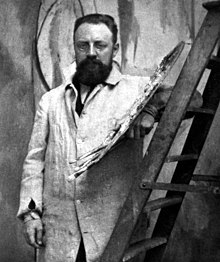
Henri Matisse, 1913, photograph by Alvin Langdon Coburn.jpg  
A photo of Henri Matisse, 1913, by Alvin Langdon Coburn

LA MOULADE 1906

By The Sea 1905

Sailor 1, 1906

Matisse's used pure colors and the white of exposed canvas to create a light-filled atmosphere in his Fauve paintings. Rather than using modeling or shading to lend volume and structure to his pictures, Matisse used contrasting areas of pure, unmodulated color. These ideas continued to be important to him throughout his career.The human figure was central to Matisse's work both in sculpture and painting. As seen from Sailor 1, the importance for his Fauvist work reflects his feeling that the subject had been neglected in Impressionism, and it continued to be important to him. At times he fragmented the figure harshly, at other times he treated it almost as a curvilinear, decorative element. Some of his work reflects the mood and personality of his models, but more often he used them merely as vehicles for his own feelings, reducing them to ciphers in his monumental designs.

Personal Reflection

Henri Matisse's style of art, although arcane, adopted a 'wild beast' style of painting, using pure colors and white on the canvas to create a form of contrast shows Henri's revolutionary impact on society. I found his daring attempt to revolutionize French Art an admirable trait, a trait that can be seen from his paintings.


credits - https://en.wikipedia.org/wiki/Henri_Matisse
          http://www.henri-matisse.net/index.html
       http://www.theartstory.org/artist-matisse-henri.htm


Chua Mia Tee


Chua Mia Tee was born in 1931 in China and moved to Singapore in 1937. Chua’s body of work includes colourful koi, majestic animals as well as panoramic views and sprawling landscapes of countries. He received training in drawing, sketching with watercolour and painting, both with oils on canvas and with Chinese ink and colours on paper under the tutelage of pioneer artists. Chua paints in a realistic style. His works display his keen eye for details and an understanding of light. He believes that art should be realistic because it reflects life.


Goldfishes (Prosperity) , 2008


Koi (2009)

I like him because he does amazingly life-like art pieces and can capture the image insanely well. I admire him for his oil paintings and how he can make the water look so realistic. It feels as if you can put your hand in and just touch the water.


Blue Macaws (1993)

I admire his art and how he makes every detail ( e.g. the feathers on the birds)  so intricate and real.


Yayoi Kusama

Yayoi Kusama was born on 22nd March 1929 in Matsumoto, Nagano, Japan. From an early age, Kusama began creating art. Vivid hallucinations such as flashing lights, auras or dense field of dots were one of the inspirations leading to the art that she creates now.


Kusama has worked with a variety of media such as painting, collage, soft sculpture, performance art and environmental sculpture. 


One of Kusama's pumpkin sculptures

Kusama inspires me with the way she uses vivid colour and intense detail in her painting. She was able to infuse her hallucinations, what she saw in her everyday life and gave meaning into her art, in her own way. 


Look at the details on the painting above!


Thank you for reading :)